
This is where I begin…
I began this blog with the intent of sharing the life experiences that have shaped me into the person I am today, but it appears that there have been many thresholds that have intervened in my life. For me, my current English class at Saginaw Valley State University is one of those thresholds. While this class was a priority to obtain my degree, I hope it will shape me into a more confident writer. I hope that I will be able to find a connection to my passion for history as a guide to the content I will be learning in the future. This far, I am extremely intrigued by the social conditions that have shaped our society. Last semester, I took a course in Sociology that completely changed my perspective on race, feminism, and nationalism. From taking that course, I realized how undereducated and bias society was and is. I am hopeful that I will be able to continue on my path of growth in knowledge and my writing skills to be able to blog my thoughts and ideas for others to ponder.
Thought one: Maps function in a rhetorical way.
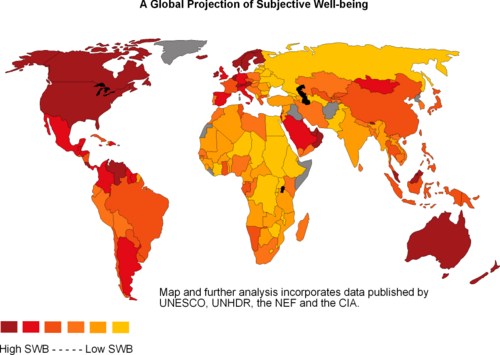
http://thomaspmbarnett.com/globlogization/2008/1/15/interesting-map.html
Above is a map that I personally found very interesting. It appears, according to the map that the shape of the world is based on the average subject well-being, or the state of comfortable, happy and healthy of individuals living in a particular area. As you may notice, Africa makes up a large portion of the world’s continents. In correlation, Africa houses the mediocre or the average person. In comparison, the western part of the map, including the United States demonstrates that the world is living with a high subject well- being. How is this map determined? Is it reliable?
After viewing a clip from West Wings and reading an article about map projections, I realized that maps are very much misunderstood. For instance in geography, specifically maps of the world people are quick to think in the mindset of what is traditionally accepted. People are often resistant to change but it is too often proven that individuals put their trust in others that do not have any reliable information or truth behind their motives. Based on sources given to me by my English Professor, personally, it is to my belief that ideas are morphed to be in the benefit of the writer and/ or speaker. For me, my opinions were particularly broadened after viewing a Youtube clip that comically judged the way societies opinions are made. First impressions, for instance, are incredibly easy to believe and are often false, or wrong characteristics of a person. Now, think of a map. It was incredibly easy for me to Google Search a random map and pick one for presentation. This map, in particular, I chose due to the fact that it has been published by an individual I have never met, nor heard of. While, as a viewer, we can never be certain that a map is completely reliable, it proves just how easy it is for an individual to be misled or for it to be misunderstood. For any audience, they are at a disadvantage to ensure the full content is a dependable representation of an issue. To support my main point, that maps are biased and rhetorical, this map shows without a doubt that it is possible that our world has been misconstrued by our observations and the information that is only known to the author. In correlation, this map is very similar to the one that much of societies education is based on. Have you ever considered if the Earth was square? Is water even wet?
Authors, Wardle and Adler-Kassner suggest that writing expresses and shares meaning to be reconstructed by the reader. In other terms, the writer can intend for their piece to be interpreted in one way but can be misread by the reader. While the writer can never be fully aware of the reader received what he/ she was trying to portray, it is the reader who carries on the meaning whether or not it is the correct meaning. This same connection between the writer and reader can be applied to maps and geography. The map I presented above is intended to prove to individuals that there is a correspondence to the size of a continent, the people that inhabit an area, and the overall satisfaction of such groups of people. While there isn’t enough information to prove this graphic to be incorrect or correct, the map appeals to readers of certain moral beliefs. In one way, the viewer can adjust the map to understand that certain parts of the world would be sought as an ideal place to live. In another way, this map can be used to represent the inequality between the living condition and quality of life, or the scale in which a majority of the world is living a mediocre lifestyle and only a percentage are presented with a better or worse lifestyle. Whether or not everyone sees each of these perspectives, it is unknown to the reader which position the writer was trying to demonstrate.
Maps and graphics appeal differently based on the rhetorical appeals presented. For instance, the map- maker may be ethical driven to demonstrate the well- being of individuals who reside in a particular country. An example of this, the United States is portrayed as having citizens who are happier and healthier than individuals that reside in Africa. The ethics of the designer may have been exaggerated to incorporate wealth as a factor of subjective well- being. In addition, the audience’s emotion may play a factor. If this map were presented at a convention for support of United States Foreign Aid, it is apparent that audiences would be more adamant to send support to areas where citizens are facing significantly less suitable of a lifestyle. Another emotion that audiences may experience when viewing this map includes superiority or nationalism. Either way, the map inflicts emotions that are presented based upon the audience. Finally, whether or not the map is presented clearly and with logic, plays a key role in which degree the map will have influence. This map, in particular, is clearly color coordinated and includes a key for reference. In all aspects, maps can be misconstrued based on the rhetorical appeals that are used when being presented.
 A Healthy Relationship